To Better is Human®

To Better is Human®

The National Center for Human Factors in Healthcare brings together human factors engineers, industrial systems engineers, industrial/organizational psychologists, usability specialists, health services researchers, and clinicians to conduct safety science, applied research, and consulting to improve healthcare quality, efficiency, reliability, and safety. By being situated within a large healthcare system, our team can take advantage of unusual access to healthcare worker and patient subjects, multiple clinical facilities, multispecialty collaborators, large medical simulation centers, and a usability testing facility.

A part of the MedStar Institute for Innovation (MI2) and the MedStar Health Research Institute (MHRI), the Center’s home and “research lab” is MedStar Health, a $4B not-for-profit healthcare organization in the Baltimore/Washington area. The MedStar Health system is academically affiliated with Georgetown University School of Medicine, and includes nine hospitals and more than twenty diversified healthcare companies with more than 100 locations. The Center benefits from established collaborations many academic institutions and hospital systems, and MedStar is part of the NIH Georgetown-Howard Universities Center for Clinical and Translational Science.


Will Resilience Engineering help healthcare rise to the next level in safety?

Conference Update

Will Resilience Engineering help healthcare rise to the next level in safety?

Announcing Workshop on Resilience Engineering in Healthcare, at the National Academies of Sciences' Keck Center in Washington DC on June 13 and 14, 2013. A first in the US, this meeting is hosted MedStar Health and by the University-Industry Demonstration Partnership (UIDP). For more information or to register, visit www.ResilienceEngineeringHealthcare.com.

How Does Human Factors Apply to Healthcare?

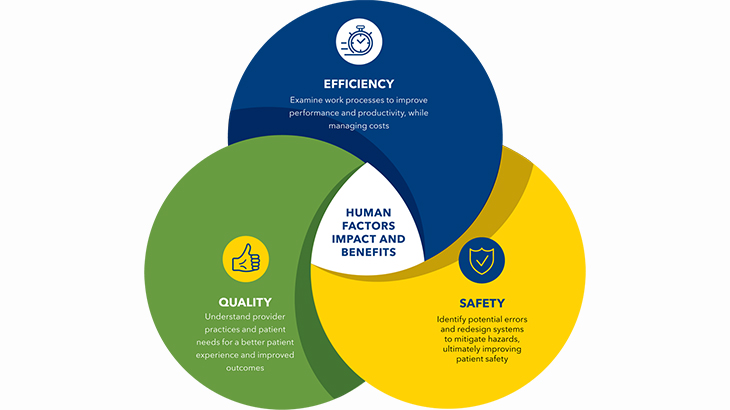
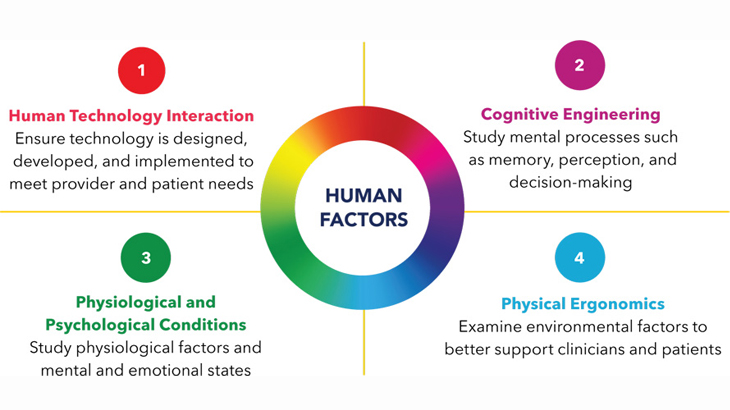
Human Factors is applied to healthcare to design processes, devices, and systems that support the work of care givers in medicine. Specific benefits of Human Factors  and System Safety Engineering applied to healthcare include:

  • Efficient care processes in medical care
  • Effective communication between medical care providers
  • Better understanding of a patient’s current medical condition
  • Implementation of effective and sustainable RCA solutions
  • Reduced risk of medical device use error
  • Easier to use (or more intuitive) devices
  • Reduced risk of health IT-related Use error
  • Easier to use (or more intuitive) health IT
  • Reduced need for training
  • Easier repair and maintenance
  • Cost savings through prevention and mitigation of adverse events
  • Saferworking conditions in medicine
  • Improved patient outcomes

Human Factors evaluations and interventions should take place early in the design and system development process. It should include tools such as work domain analysis, function allocation, probabilistic risk assessment, usability testing, among others.

—————————————————————————————————————————————-

Upcoming Conferences:

  • Will Resilience Engineering help healthcare rise to the next level in safety?
    Announcing Workshop on Resilience Engineering in Healthcare, at the National Academies of Sciences’ Keck Center in Washington DC on June 13 and 14, 2013. A first in the US, this meeting is hosted MedStar Health and by the University-Industry Demonstration Partnership (UIDP). For more information or to register, visit www.ResilienceEngineeringHealthcare.com.
  • We are pleased to announce that our Center, along with our parent organization, the MedStar Institute for Innovation, will be hosting the Human Factors and Ergonomics Society’s 2013 Symposium on Human Factors and Ergonomics in Health Care, March 11–13 2013 at the Baltimore Marriott Waterfront Hotel in Baltimore, Maryland. For more information click here.

  • Dr. Fairbanks will be speaking at the 6th Annual South Carolina patient safety symposium, April 17–18 2013 at the Columbia Metropolitan Convention Center in Columbia, SC. For more information click here.
  • Dr. Fairbanks will be speaking at the Michigan Society of Healthcare Risk Management meeting, May 22-24 2013 in Grand Rapids, MI. For more information click here.

—————————————————————————————————————————————-

The National Center for Human Factors in Healthcare is a collaboration of:

MedStar Health Research InstituteMedStar Institute for Innovation   


Updates:

Congratulations to our Director Dr. Terry Fairbanks who has been appointed to serve on the Emergency Medicine Patient Safety Foundation Board of Directors. (5/1/13) ___________________________________ We are pleased to welcome Nat Benda to our team as our newest research assistant. Natalie Benda has a bachelor's degree in Industrial Engineering from Purdue University. Her bio is available here. (1/17/13) ___________________________________ We are pleased to announce that our Center, along with our parent organization, the MedStar Institute for Innovation, will be hosting the Human Factors and Ergonomics Society’s 2013 Symposium on Human Factors and Ergonomics in Health Care, March 11–13 2013 at the Baltimore Marriott Waterfront Hotel in Baltimore, Maryland. For more information click here. (12/17/12) _________________________________ We are very pleased to welcome Raj Ratwani, PhD, to our team as Senior Human Factors Research Scientist. Raj brings years of experience in human factors research and consulting. His bio is available here. (9/5/12) _________________________________ We are pleased to see our center’s ongoing close collaboration with MedStar’s Simulation & Training Environment Laboratory (SiTEL) be strengthened by the appointment of Terry Fairbanks as Acting Director. Dr. Fairbanks will also continue his role as Director of the National Center for Human Factors Engineering in Healthcare. (8/16/12) _________________________________ MedStar Health to become a 10-hospital health system with the addition of Southern Maryland Hospital Center. Press release here. (7/30/12) _________________________________ Congratulations to Center Director Terry Fairbanks MD MS, who is PI for a newly awarded 2-year AHRQ R18 simulation grant to compare a serious game training system to mannequin-based training. This project is being led by Dr. Fairbanks and Faculty Associate Tamika Auguste MD FACOG, director of OB Simulation at MedStar Health, and forms a collaboration between our Center, MI2's SiTEL simulation center, and the MedStar Washington Hospital Center Dept. of Ob/Gyn. (7/1/30) _________________________________ We are proud to announce the addition of Margaret Meadors, MS to our team as a Research Assistant. Margaret's bio can be found here. Mrs. Meadors is an Applied Experimental Psychology Ph.D. student and teaching fellow at Catholic University. (6/25/12) _________________________________ We are proud to announce the addition of Danielle DeBacker, MA to our team as a Research Assistant. Danielle's bio can be found here. Ms. DeBacker recently completed her Master’s degree in Bioethics at Case Western Reserve University. (6/25/12) _________________________________ Zach Hettinger, MD MS, Director of Information Technology Research, has recieved the NIH Loan Repayment Program in Clinical Research Award. Recipients of this prestigious award are selected based on the quality of their current research program, and on their promise as a developing independent researcher. The award repays a substantial portion of recipients medical education costs. Congratulations to Dr. Hettinger. _________________________________ We are proud to announce the addition of Natalie Abts, MS to our team as a Human Factors Specialist. Natalie's bio can be found here. Ms. Abts recently completed her Master’s degree in Industrial Engineering with a focus on Human Factors and Ergonomics from the University of Wisconsin. (6/11/12) ________________________________ We are pleased to welcome Angie Hernandez, MS to our team as a Senior Human Factors Specialist. Angie's bio can be found here. She comes with extensive experience with the Department of Defense, including human systems integration and usability. (5/7/12) _________________________________ The NCHFEH in collaboration with the Georgetown School of Medicine is currently holding an elective course on Systems Safety and Human Factors Engineering. Eight 4th-year medical students are learning current methods and thinking in how to create safer, better-functioning healthcare systems and how to apply these methods to their future practices. (3/26/12) _________________________________ Congratulations to Sarah Parker PhD, who is PI of a newly awarded AHRQ F32 grant. Dr. Parker will be studying methods to measure team coordination and leadership behaviors in the trauma resuscitation setting. The three year study will take place at the MedStar Washington Hospital Center and Childrens National Medical Center. A strong multidisciplinary mentorship team has been gathered, lead by Dr. Terry Fairbanks and Dr. Randy Burd as primary mentors. Other members of the mentorship team include Dr. Deborah Boehm-Davis (GMU), Dr. Doug Wiegmann (Univ. Wisconsin), and Dr. Steven Yule (Harvard). Dr. Jack Sava (Director of Trauma at WHC) will serve as a co-investigator. ________________________________ We are proud to announce the addition of Dr. Sarah Henrickson Parkeras a Human Factors Research Scientist. Dr. Parker recently completed her PhD in Industrial & Organizational Psychology from the University of Aberdeen, Scotland. (11/22/11) _________________________________ Congratulations to Center faculty member Dr. Zach Hettinger who recently won an ASHRM grant, entitled “An Evidence Based Framework for Root Cause Analysis Safety Solutions.” This project expands on the work of Drs. Terry Fairbanks, Kate Kellogg, and Dr. Hettinger that began at the University of Rochester (funded by EMPSF) and continued at the Washington Hospital Center (funded by the Latham Foundation). _________________________________ Congratulations to Scientific Director Dr. Vicki Lewis (PI) and Director Dr. Terry Fairbanks (Deputy PI) for the recent contract award via CNA for AHRQ’s ACTION 2 Task Order, “Identifying and Aligning Work-System Factors to Reduce Healthcare-Associated Infections.” This project will apply a sociotechnical systems approach to healthcare associated infections in the renal failure population. _________________________________ Congratulations to Dr. Robert Stephens was awarded a grant from the Emergency Medicine Patient Safety Foundation through the Emergency Medicine Foundation for Discovering the Barriers and Facilitators to Timely Disposition of Patients from the Emergency Department _________________________________ One of our Center’s initiatives, using the Hazard Alerting Loop in the SICU setting, gets publicity in the Washington Post. _________________________________ Press release announcing the National Center for Human Factors Engineering in Healthcare